How Counterfeit Toner Gets Into the B2B Supply Chain and the Costs Involved
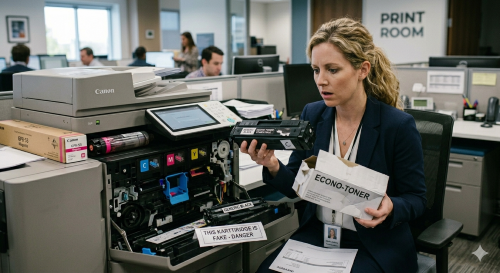
Counterfeit toner and ink doesn’t announce itself. It arrives in a box that looks right. It installs without an error message. It starts printing. And then somewhere between page 50 and page 300, things start going wrong in ways that are expensive, frustrating, and completely preventable.
For B2B buyers across the Quad Cities managing printer fleets of any size, this is worth understanding before the damage happens, not after.
Where Counterfeit Product Comes From
The vast majority of counterfeit toner and ink originates overseas and enters the market through low-accountability channels. Third-party marketplace sellers on major e-commerce platforms. Gray-market distributors offering prices that look too good to pass up. Bulk wholesale platforms that prioritize volume over verification.
The product is manufactured with substandard toner formulations that don’t match the fuser temperature requirements of the target printer. Toner that doesn’t fuse properly either smears and fades on the page or creates excessive heat buildup in the fuser assembly, which shortens fuser life and in some cases causes permanent mechanical damage.
Smart chip counterfeiting has become increasingly sophisticated. A chip that communicates false supply levels to the printer doesn’t just give you inaccurate readings. It can mask error states that would otherwise alert you to a developing problem before damage occurs.
What Counterfeit Product Actually Costs a Small Business
The visible cost is straightforward: a cartridge that fails at 400 pages instead of delivering its rated 2,000. You paid for 2,000 pages and got 400. That’s a loss on the cartridge itself before anything else happens.
The less visible costs are harder to quantify until they show up on a repair invoice.
- Fuser replacement on a mid-range laser printer: $150 to $350 in parts and labor.
- Drum unit damage from abrasive toner formulations: an additional $80 to $200.
- Printhead damage in inkjet devices from incompatible ink chemistry: in some cases, the printhead is not repairable and the device requires replacement.
In cases where counterfeit product causes repeated fuser failures or printhead damage, the total repair cost exceeds the device’s replacement value. You didn’t save money on the cartridge. You paid for a new printer.
The Warranty Dimension
Most printer manufacturers explicitly void the device warranty when third-party supply damage is the identified cause of failure. This is not a gray area in the fine print. It is a standard clause in HP, Brother, Canon, and most other major manufacturer warranty agreements.
A verified compatible toner cartridge from a reputable B2B supplier does not trigger this clause. The product is tested to ISO standards, performs within the device’s operational specifications, and the supplier carries a warranty covering device damage caused by their cartridges. Counterfeit product fails on all three counts.
The distinction matters when your repair technician is diagnosing the cause of a fuser failure and your device is 18 months old.
How Counterfeit Product Reaches B2B Buyers
The sourcing patterns that expose B2B operations to counterfeit risk are consistent. Purchasing from third-party sellers on Amazon, eBay, or similar marketplace platforms where the actual manufacturer of the product is unverifiable. Responding to unsolicited bulk pricing offers via email or cold outreach. Buying from unfamiliar online retailers offering prices 60 to 80 percent below market rate without clear certification documentation.
The price signal is usually the first indicator. Legitimate compatible product from a verified supplier saves 40 to 70 percent compared to OEM. Product priced below that range with no verifiable certification trail is worth treating as suspect until proven otherwise.
How to Verify Your Supplier
For B2B buyers managing print supply for a Quad Cities operation, supplier verification comes down to four questions.
- Does the supplier carry ISO 9001 certified product? This covers the manufacturing process quality standard. A legitimate compatible supplier can document this.
- Is the product tested to ISO/IEC 24711 and 24712 yield standards? These are the international standards for page yield verification. Rated yields on certified product are tested, not estimated.
- Does the supplier carry a warranty that covers device damage caused by their cartridges? Any supplier confident in their product quality backs it with this coverage. If they don’t offer it, that tells you something.
- Can you call a real person when something goes wrong? A local B2B supplier with a physical address and a phone number that reaches a person in your market is accountable in a way that a marketplace seller is not.
The Practical Answer for Quad Cities B2B Operations
The counterfeit risk is not an argument for paying OEM prices on every cartridge. It’s an argument for buying verified compatible product from a local supplier who carries the certifications, backs the product, and has a stake in your equipment continuing to run.
That combination, verified product plus local accountability, is what separates a legitimate compatible cartridge from a gray-market risk. For business printers running at any real volume across a small office, the supplier relationship is worth establishing once and maintaining, rather than re-evaluating every time a lower price shows up in an email.
This article is part of the CartridgeInkQC.com B2B Toner and Ink Series for Quad Cities small businesses. The full guide covers OEM vs. compatible decisions, cost-per-page calculations, and how to build a standing supply system. Read the complete B2B Toner and Ink Guide here.